The Internet of Things The Internet of Things (IoT) is no longer a vision of the future – it is a central component of our digital everyday lives. From smart homes and intelligent traffic management to networked industrial plants: more and more devices communicate wirelessly and enable new, efficient processes.
But what exactly is IoT?
The Internet of Things (IoT) describes a network of physical devices connected to each other via the internet. These devices – also called "smart devices" – collect data, exchange it in real time, and react to environmental factors or user commands. This is made possible by sensors, actuators, software, and wireless communication protocols such as Wi-Fi, Bluetooth, or mobile communication standards like 5G.
IoT in practice - examples from various industries
- Smart home: Intelligent thermostats automatically regulate the room temperature, smart lighting systems adapt to the time of day, and electronic door locks allow keyless access via smartphone or code entry – safe and convenient.
- Smart Mobility: Modern vehicles are equipped with IoT technology to process traffic information in real time, enable autonomous driving, or optimize charging infrastructure for electric vehicles.
- Industry 4.0: In production, IoT-supported machines ensure predictive maintenance by detecting malfunctions early and preventing breakdowns.
Our IoT innovation: Wireless communication for smart applications
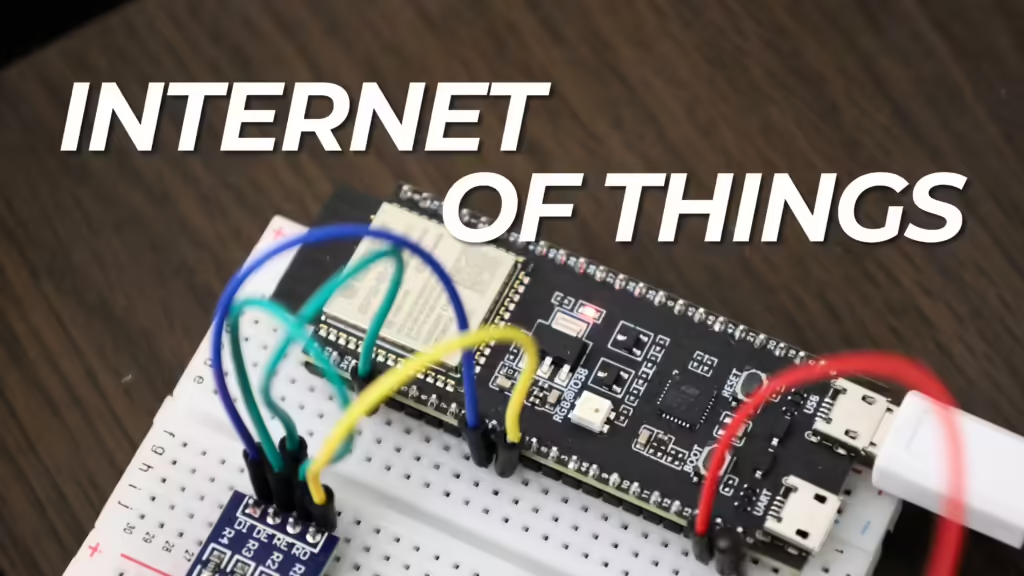
As a software company, we have CIIT-Software expands the possibilities of IoT by We used a microcontroller to communicate with a serial bus via WiFi, read data, and switch relays. The entire system is linked to a web application that allows us to control the process. We are using a [method] for our project ESP32-S3 Development board equipped with a WiFi module, BLE 5 and several hardwareUART-is equipped with interfaces for serial communication.
In simple terms, our server sends a structured byte sequence to the ESP32-S3, which processes it and forwards it to one of the devices on the bus system. There, checksums are validated, and either sensor values are read or relays are switched. The device then sends a response back to the ESP32-S3 via the bus and finally to the server. The web application is then updated accordingly.
Basically, it is a serial, asynchronous Half-duplex-Communication via hardware-UART-interfaces are implemented. In our case, we use the RS-485 communication protocol, which is widely used in industrial applications. Signal transmission occurs via differential signals on two lines, with communication regulated by voltage differences:
- Send: The line is live.
- Receiving: The line has no voltage.
To convert the data into the corresponding electrical signals that can be processed by the devices on the bus, we use a MAX485 module as an interface between the Arduino and the bus system. We expanded the whole thing with a BLE-Connection, via which WiFi access data can be set. With the ESP32-S3, we therefore have a powerful platform that provides us with a solid basis for future IoT projects.