Truly tailor-made solutions only emerge through individual development.
In an increasingly complex working world, many companies face the challenge of optimizing their internal processes, meeting rising demands, and simultaneously creating an attractive environment for their employees. Processes are becoming more diverse, interfaces more numerous, and expectations for speed and flexibility are higher than ever.
What many people underestimate:
The software used plays a central role – not just as a tool, but as the backbone of daily work. And this is precisely where the dilemma often begins.
Standard software is widely used - and for good reason.

It's quick to deploy, inexpensive to implement, and reliably covers many common processes. However, it reaches its limits where companies differ from one another: with individual workflows, industry-specific requirements, and established structures. What works universally in theory often feels like a straitjacket in practice.
In this blog post, I would like to take you along – not the technical, but the strategic side of our work at CIIT-Software. Our strength lies not only in development, but above all in Advise and understand:
What does your company really need to work more efficiently, scale better, and at the same time relieve your employees of some of their daily work burdens?
Our experience shows:
Many of our clients rely on standard software solutions that have become outdated – grown, adapted, and expanded over time, but never truly questioned. Together with our clients, we take these systems to the next level – through customized extensions, individual modules, or the consistent modernization of the existing architecture.
This finally turns software into a tool that can be used for self-reliance. adapts to the company – and not the other way around..

The result?
Increased productivity through smooth processes, less frustration through intuitive operation and noticeably higher motivation in the team – because good software supports people instead of holding them back.
Do you remember the last time you moved to a new apartment?
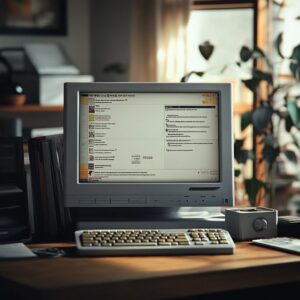
You enter the empty room, everything is new – but as soon as you start bringing in your furniture, you realize: not everything fits. The wardrobe is too big for the alcove; the old sofa looks out of place. And so begins the search for solutions – often makeshift, sometimes creative, rarely perfect.
It feels similar when companies today work with software solutions that come from another era. Anyone who ordered something from a large furniture store a few years ago might remember those quirky, black user interfaces: a blinking cursor on a black background, white text – and a system that looks like it was still being developed on a 19th-century computer. MSRunning DOS. Back then, that was a reality – even for large retail chains.
How often have you seen employees navigating through endless black menus using the arrow keys on the keyboard, only to receive the answer: "Yes, we still have two in stock."„
At CIIT Software, we live and breathe custom software.
We at CIIT Software experience this regularly as well. In many projects, we don't help clients develop entirely new applications, but rather... during the modernization of existing systems – some of them actually date back to the 90s.
For us, this is not a tiresome obligation, but an exciting challenge.
Because these projects are about far more than "just" new code:
The goal is to analyze existing processes, unravel hidden logic, design a clean architecture – and guide customers on their journey to a new generation of software.
In my case, I have acquired more companies over the years at the Modernization or realignment of their existing applications supported more than in classic new developments.
Why? Because the added value is immediately noticeable – both for management, which finally regains control over its systems, and for employees, who no longer have to struggle through outdated interfaces but can work with a modern, intuitive user interface.

One of the most frequent questions that many business leaders and other decision-makers ask themselves is certainly: What are the cost/benefit factors of this type of software?
Of course, standard software may seem cheaper at first glance – but the problem usually lies in the details. Over the years, ongoing license fees, additional costs for modules, support contracts, and expensive customizations accrue.
Many software packages offer numerous functions. However, as soon as additional features are needed, this can become cumbersome and expensive. Processes are not integrated with the company's own structure, and approval processes and workflows are not mirrored. This leads to workarounds. These workarounds vary across departments, meaning that the next person in the workflow has to adapt to different inputs. In my experience, this is a real efficiency killer.
How does custom software help here?
If your company has many different workflows, these can be optimized and linked to different departments. This also means, of course, that the same forms can be adapted differently for different user groups. Scaling and control of the various modules is directly under your control and that of the development team supporting you. The possibilities are virtually endless.
In my current project, we are expanding our established workflow, from initial prototypes to final delivery at the factory, for another department. This means that all functions and interfaces need to be redesigned. You won't have to try to explain your use case to another company and then only receive a half-baked solution.
The real advantage:
A well-designed, customized system scales with the company., instead of burdening it with growing licensing models.
With custom software, technological dependencies are a thing of the past. Instead of proprietary systems, you can rely on open standards. This protects you from... Vendor lock-in, i.e., dependence on a specific provider who may eventually remove features or increase prices.
Standard software has its place – but it's not a panacea. When processes become more complex, requirements increase, and systems have evolved over years, it quickly reaches its limits.
This is precisely where custom software demonstrates its strength:
She adapts to the company – not the other way around.
It creates clarity, reduces friction losses and opens up opportunities for real efficiency.

Software that works – because it was understood.